
“POS” is a short internet term that pops up in texts, comments, and DMs. Most of the time, it stands for “piece of sh*t,” a rude way to call someone or something bad. It’s a harsh word, so people mostly use it in casual chats between friends.
The meaning of “POS” isn’t always the same, though. In some texts, it can mean “parent over shoulder,” a quick warning that someone’s watching the screen. In business talk, it usually means “point of sale,” referring to checkout systems in stores.
By 2026, context is everything when reading “POS” online. The platform, tone, and topic all shape which meaning fits. Understanding these clues helps avoid mixed-up or awkward conversations.
Understanding the Core Meaning of POS in Slang
In most slang contexts, “POS” stands for “piece of sh*t.” It’s a blunt, informal insult used to describe a person, object, or situation seen as bad, unfair, or low quality.
- It’s most often aimed at people during arguments or gossip.
- It’s also used to complain about broken devices or bad products.
- The tone ranges from serious anger to joking exaggeration.
Different Meanings of POS in Modern Slang
“POS” isn’t a one-meaning term. The letters get reused across very different contexts.
| Meaning | Common Setting | Tone |
| Piece of sh*t | Texts, social media, arguments | Harsh, negative |
| Parent over shoulder | Texting between teens | Cautious, playful |
| Point of sale | Retail, business, tech | Neutral, technical |
| Positive (as “/pos”) | Tone indicators online | Friendly, clarifying |
Knowing which meaning applies comes down to reading the surrounding conversation, not just the letters themselves.
Why People Use POS in Slang
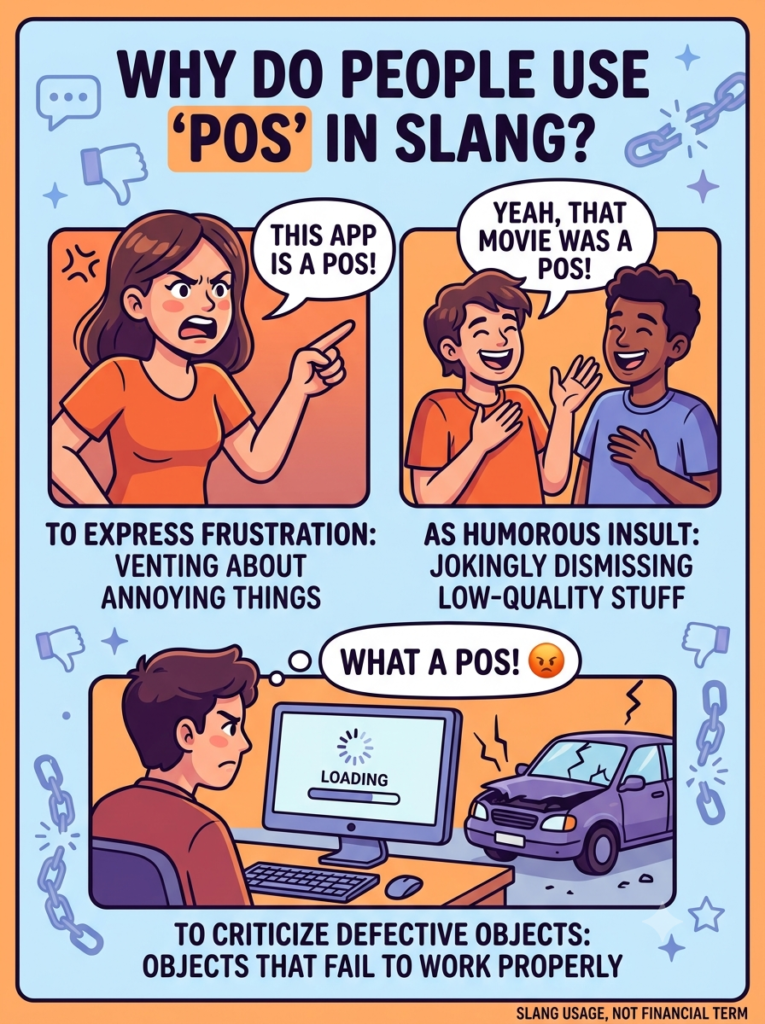
Short slang like “POS” spreads because it does a lot of emotional work in very little space.
- Speed: three letters are faster to type than a full insult.
- Intensity: it compresses strong judgment into a quick label.
- Familiarity: once a term is widely known, people default to it out of habit.
- Softening: initials feel slightly less harsh than spelling the full phrase out.
How POS is Used in Real Conversations
Seeing “POS” in context makes its meaning much clearer.
- Group chat: “Don’t invite him, he’s a total POS.”
- Gaming chat: “Camping the whole round? Pos move.”
- Product complaint: “This charger is such a POS, broke in a week.”
- Texting shorthand: “Can’t talk long, POS 👀” (parent over shoulder).
Emotional Impact of Calling Someone a POS
Calling someone a “POS” is rarely neutral — it signals strong feelings, even in casual settings.
- It often reflects anger, betrayal, or frustration toward the person.
- Among close friends, it can be exaggerated for comedic effect.
- In public comments or arguments, it usually reads as a genuine insult.
- Repeated use in relationships can point to real conflict or resentment.
Variations and Related Slang Similar to POS
Several other slang terms carry a similar tone or purpose to “POS.”
- POS energy — describing someone’s overall bad vibe or behavior.
- Trash — a softer, more general insult for something low quality.
- Toxic — used for people whose behavior harms others emotionally.
- Garbage — similar to “trash,” often used for products or performances.
- L take — a dismissive way to call someone’s opinion bad.
POS in Texting vs Social Media
The way “POS” is used shifts slightly depending on the platform.
| Platform | Typical Use | Example |
| Texting | Insult or “parent over shoulder” warning | “he’s such a POS” / “POS, ttyl” |
| TikTok comments | Public callouts, debates | “bro really did that? pos energy” |
| Sarcastic captions or jokes | “pos behavior fr 😂” | |
| Gaming chat | Competitive banter | “pos move camping like that” |
| Business email | Point of sale systems | “the POS crashed at checkout” |
Table: Summary of POS Meanings in Slang
| Term | Full Meaning | Category |
| POS | Piece of sh*t | Insult |
| POS | Parent over shoulder | Warning |
| POS | Point of sale | Business/tech |
| /pos | Positive connotation | Tone indicator |
The Linguistic Roots of POS Slang
“Piece of sh*t” existed as a spoken insult long before texting existed, going back to informal English speech in the 20th century. As texting culture grew in the early 2000s, people shortened the phrase to save time and effort, and “POS” carried that insult into digital spaces. Over the following decades, gaming communities, forums, and social media all picked it up, cementing it as recognizable slang.
Is POS Always an Insult?
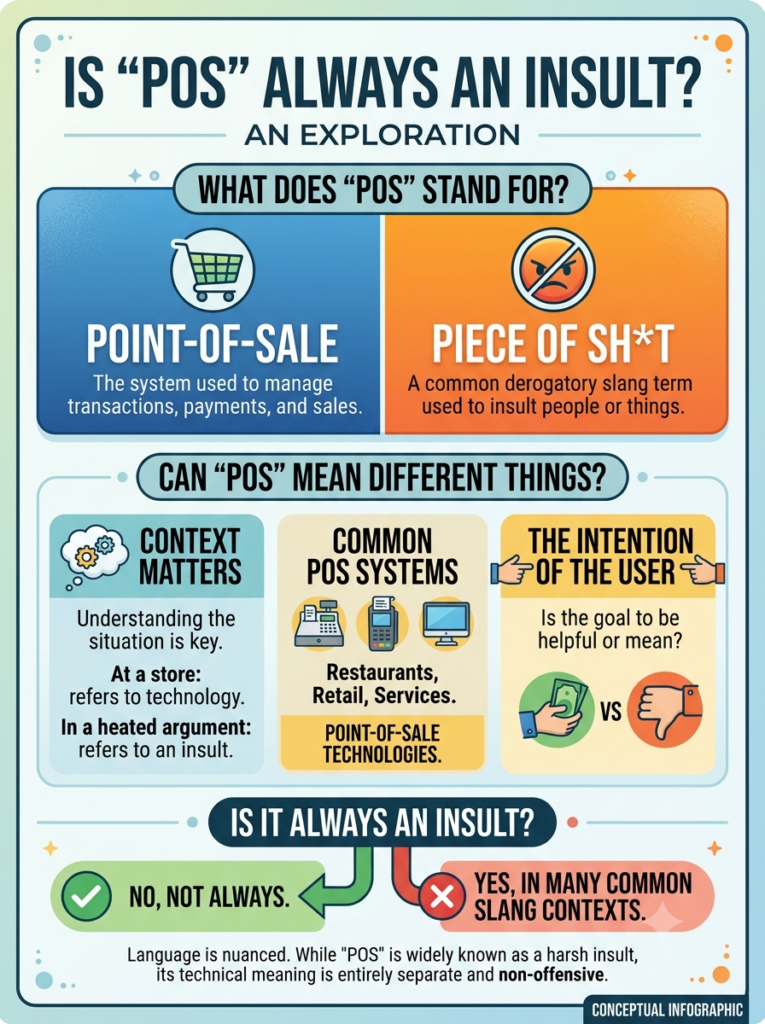
Not always — but it’s the most common meaning by far.
- Usually an insult: describing a person’s bad behavior or character.
- Sometimes technical: referring to point-of-sale systems in retail settings.
- Occasionally a warning: “parent over shoulder” in texting contexts.
- Rarely playful: among very close friends, used jokingly without real anger.
How Tone Changes the Meaning (Expert Breakdown)
Language researchers who study internet slang point out that short insults like “POS” rely almost entirely on tone and context to land correctly.
- Punctuation and emojis can soften or sharpen the message.
- Relationship closeness changes whether it reads as a joke or an attack.
- Platform norms shape whether it’s read as harsh or casual.
- Capitalization (all caps vs lowercase) often signals intensity.
When to Use (and NOT Use) POS
- ✅ Use it casually among close friends who understand your tone.
- ✅ Use it to vent about a broken product or bad experience.
- ❌ Don’t use it in professional emails or workplace chats.
- ❌ Don’t use it toward strangers or in public arguments, where it can escalate conflict.
Examples of POS in Conversations
- “This laptop is such a POS, it keeps freezing.”
- “He canceled last minute again — total POS move.”
- “lol can’t text, POS, talk later.”
- “The store just upgraded their POS system.”
- “pos behavior ngl 😭” (Instagram comment).
Cultural Notes and Social Insight
“POS” is most commonly used in English-speaking online spaces, especially in North America and parts of Europe. Younger internet users tend to recognize it instantly as slang, while older generations or professional audiences are more likely to think of “point of sale” first. This generational gap is a common source of confusion, especially in mixed-audience settings like workplace group chats.
Frequently Confused Terms With POS
- POV — “point of view,” used for perspective-based content, not an insult.
- POP — usually means “popular” or “point of purchase,” unrelated to POS.
- PoS (crypto) — “Proof of Stake,” a blockchain term, common in crypto discussions.
- OFC — “of course,” a totally different, friendly abbreviation.
Is POS Considered Profanity?
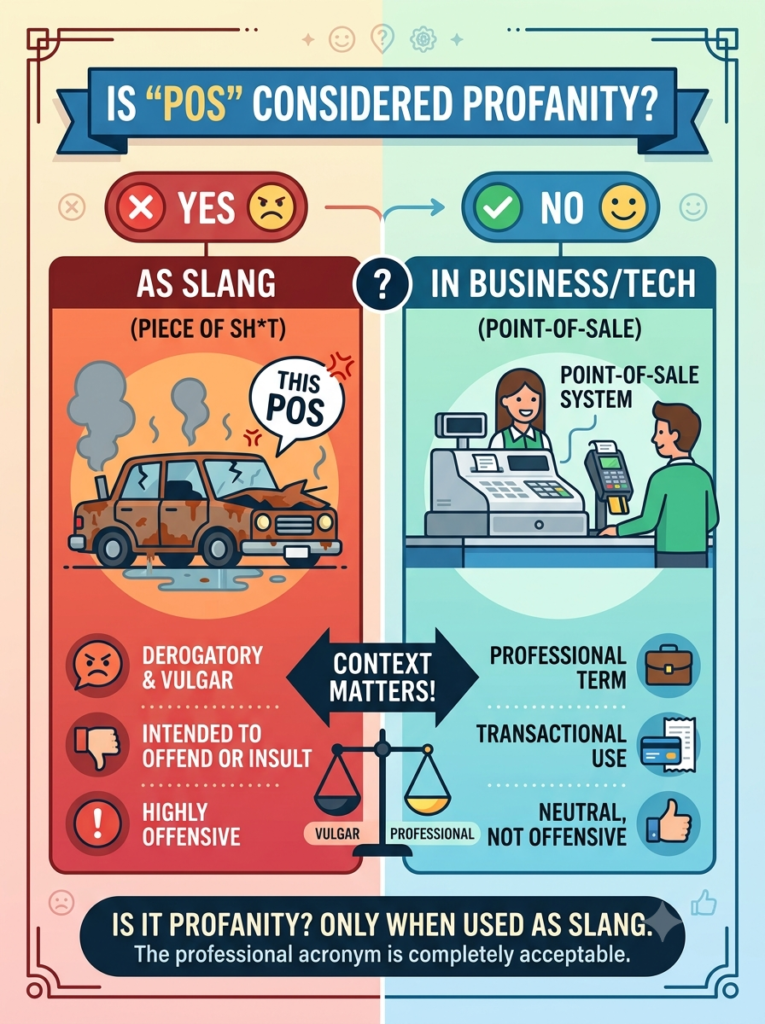
Yes, in its most common slang sense, “POS” is a softened version of a vulgar insult, so it’s generally seen as offensive or crude, even though it’s abbreviated.
Parent Over Shoulder — A Different Slang Meaning
In texting, “POS” can also mean “parent over shoulder,” a quick heads-up that someone’s parent might be reading the screen. This meaning is far less common today but still appears occasionally in older slang guides and teen texting habits.
Is POS Used Globally?
“POS” is widely recognized across English-speaking countries, but its use and familiarity vary elsewhere.
- North America and UK: widely known, especially the insult meaning.
- Non-English-speaking regions: more often known through gaming or English-language social media.
- Business contexts worldwide: “point of sale” remains the dominant meaning.
Why Knowing POS Matters Today
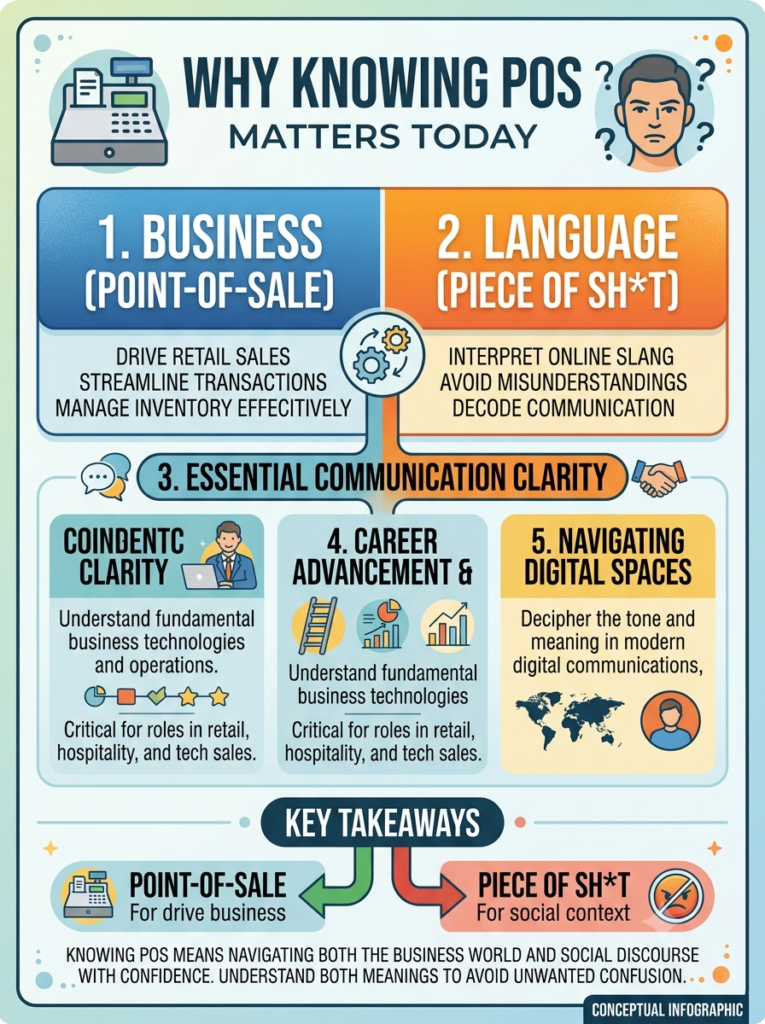
Understanding “POS” helps you read digital conversations accurately and respond appropriately.
- It prevents misreading a harmless retail conversation as an insult.
- It helps you gauge whether a message is joking or genuinely upset.
- It keeps you from using it inappropriately in professional settings.
- It builds general fluency in fast-changing internet slang.
Also Read About This On Punello.com
Example Sentences Using POS (Custom & Contextual)
- “Ignore him, he’s just being a POS today.”
- “Our new POS system speeds up checkout a lot.”
- “Can’t reply fully, POS, I’ll text later.”
- “That was such a POS thing to do to your friend.”
- “The reviews called the product a complete POS.”
Frequently Asked Questions 🗣
Is POS always an insult?
No, it can also mean “point of sale” in business or “parent over shoulder” in texting.
What does POS mean in slang used by online communities?
It usually means “piece of sh*t,” a rude insult for a person or thing. It’s common in forums, comments, and chats.
What does POS mean when used in online gaming discussions?
In gaming, POS often calls out a bad play or unfair move. It’s mostly casual banter, not a serious insult.
Explain the slang meaning of POS in texting and social media?
POS is a harsh way to say someone or something is bad. Tone and context decide how serious it is.
How to explain the slang term POS to someone unfamiliar with internet jargon?
Tell them POS is short for a rude insult, “piece of sh*t.” Say it’s mostly used in casual, informal chats.
What are common situations where the acronym POS is used in derogatory slang?
It’s used during arguments, gossip, or complaints about someone’s behavior. It also shows up when venting about bad products.
How to choose the best POS system for a small retail business?
Look for easy setup, low fees, and good customer support. Compare options like Square, Shopify, or Clover.
Is using POS slang considered offensive in professional communication?
Yes, it’s considered rude and unprofessional. It should be avoided in work settings.
Resources for understanding common internet slang terms and their origins?
Sites like Urban Dictionary and Merriam-Webster track slang meanings. Wiktionary is also useful for word origins.
Conclusion (Final Thoughts) 📤
“POS” is internet slang that usually means “piece of sh*t,” a rude insult used online. It can also mean “parent over shoulder” or “point of sale,” depending on the setting. Context always decides which meaning fits best.
Understanding “POS” helps you read tone and avoid mixed-up conversations. It’s a strong word, so it’s best used carefully, mostly with close friends. As always, thinking before typing keeps online chats clear and respectful.

Hi, I’m an SEO specialist with a strong passion for digital marketing and search optimization. I focus on understanding how search engines work and how websites can improve their visibility through effective SEO strategies.
I enjoy working with data-driven approaches, including keyword research, on-page optimization, technical SEO, and content strategy. I believe every website has the potential to grow and reach new heights with the right techniques and consistent effort.
I value continuous learning and always stay updated with the latest trends and best practices in the digital world. My goal is to keep improving my skills and knowledge while exploring new opportunities in the field of SEO.